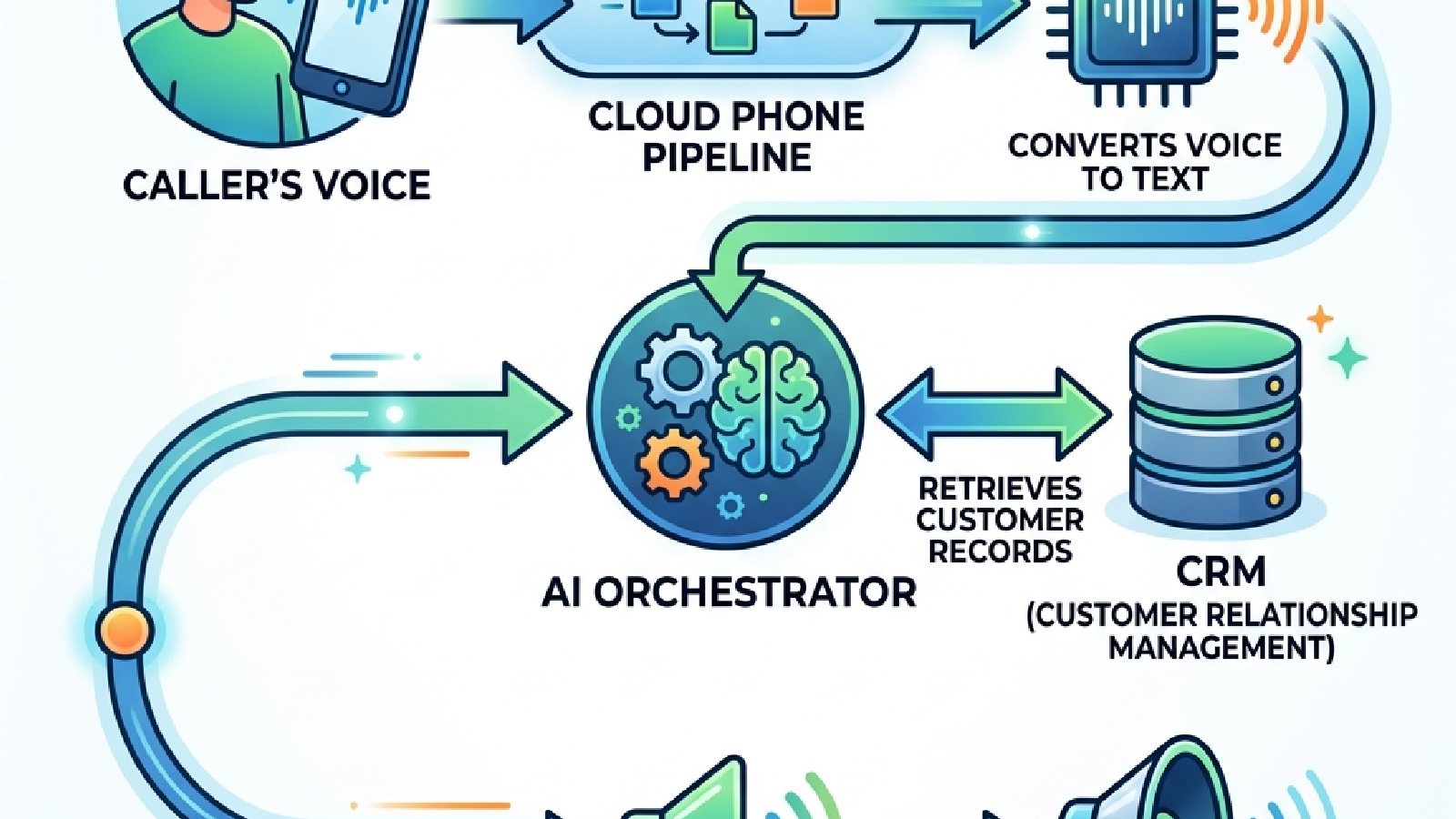
Running a traditional call center has become one of the most expensive parts of modern business. High employee turnover, long training times, and rising staff wages make it very hard for companies to scale their customer support.
For years, businesses tried to solve this problem using old phone menus. We have all dealt with them: "Press 1 for Sales," "Press 2 for Billing," or "Press 3 to speak with a representative." These systems were designed to cut labor costs, but they created a terrible experience for customers. Callers ended up stuck in long loops, pressing buttons, or waiting on hold for twenty minutes just to ask a simple question.
Modern voice AI agents completely turn the model on its head. Instead of forcing callers to press buttons on a keypad, smart AI voice agents can listen to real human speech and understand what the caller wants. They can also reply in natural human language and give real-time answers to common queries. By implementing intelligent voice agents, enterprise businesses can reduce their call center costs by up to 60% and give callers 24/7 answers.
Comparing Old Phone Menus to Smart AI Voice Agents
Traditional voice systems rely on rigid decision trees, while modern voice AI platforms use fast streaming models to hold natural conversations.
Input Handling: Legacy systems require keypad button presses. AI calling agents listen directly to human speech and filter out background noise automatically.
Reasoning Capabilities: Old phone menus follow pre-written, rigid scripts. Intelligent voice agents use smart language models that understand real human language, accents, and context.
Response Speed: Keypad menus are fast but can only play rigid recordings. Voice AI agents process complex requests and respond in natural speech in less than half a second.
Memory and Context: Legacy systems forget caller details as soon as the line disconnects. Voice AI agents remember past conversations and sync all caller updates directly with your business software.
Handling Interruptions: Old phone menus force callers to listen through long lists of recorded options. Voice AI features full barge-in detection, which lets callers interrupt the bot naturally at any point in the conversation.
The 4 Simple Layers of a Voice AI System
To make an AI voice agent respond naturally without awkward silences, developers build the platform using four underlying layers:
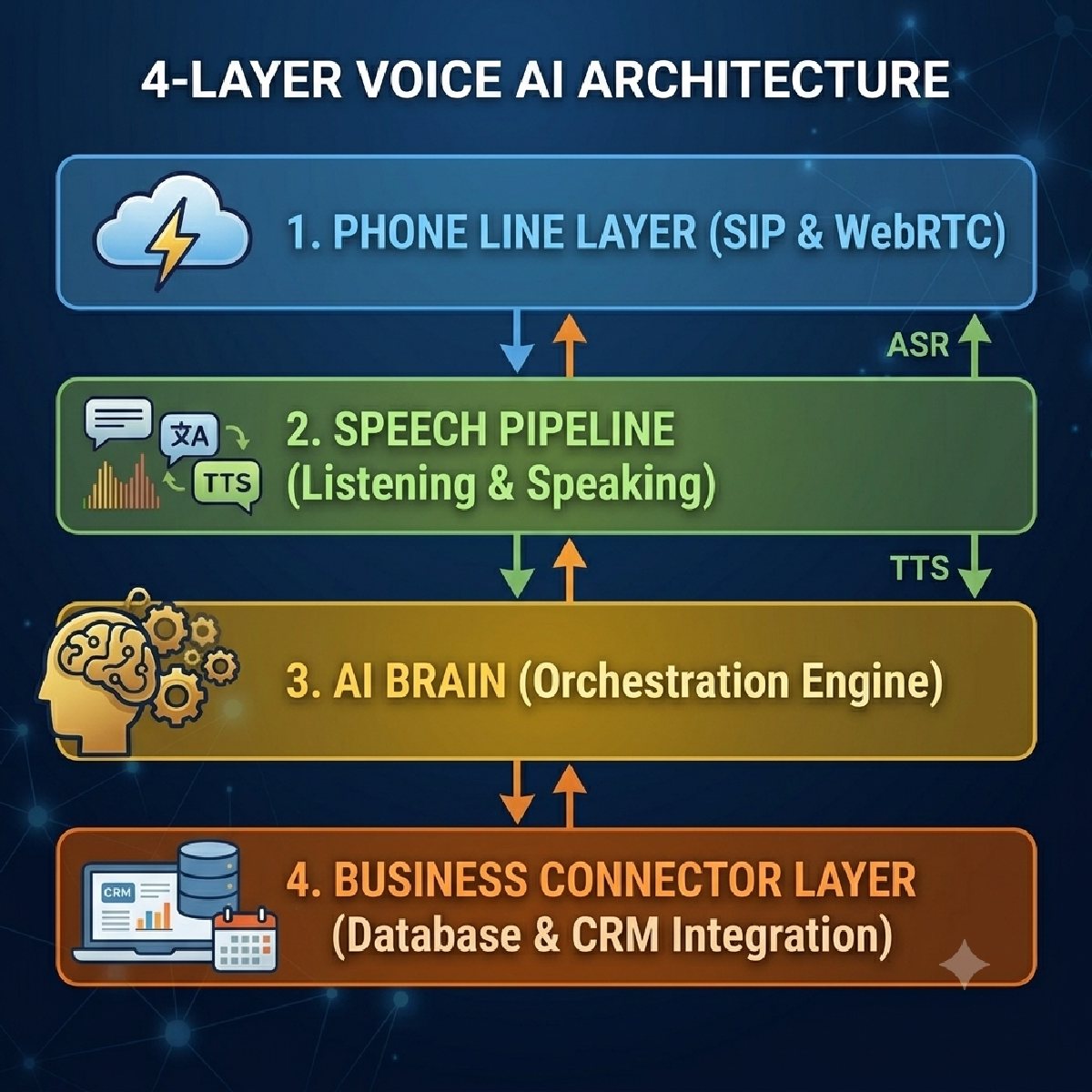
1. Phone Line Layer This handles the actual phone call using digital networks like WebRTC or cloud telephony. It keeps audio streaming back and forth without lag or dropped packets.
2. Speech Pipeline (Listening and Speaking) This functions as the eyes and ears of your AI voice agent:
Ears (Speech-to-Text): Takes spoken words from the caller, removes background noise, and converts the speech into digital text in milliseconds.
Mouth (Text-to-Speech): Takes the written response generated by the AI and converts it into natural human speech without robotic pauses.
3. The AI Brain This reads the transcribed text, figures out what the customer is asking for, and crafts a clear answer. Because this layer processes sensitive customer information, companies must follow proper enterprise safety standards as detailed in our guide on ChatGPT Business Data Security.
4. Business Connector Layer This ties the AI voice agent to your internal software such as your CRM, inventory management, or booking systems. This allows the AI to check or alter account details, reschedule appointments, and even send out order confirmations or cancellations during the call.
How Voice AI Cuts Call Center Costs by 60%
Replacing repetitive manual support tasks with automated voice agents transforms your business expenses across four key areas:
Human support calls usually cost between $4.50 and $6.00 per call due to staffing wages. An automated voice agent drops that cost down to $0.30 to $0.90 per call.
A human support agent can only handle 1 call at a time. An AI voice platform can answer thousands of incoming calls simultaneously without any wait time.
AI voice agents run 24 hours a day, 7 days a week, completely eliminating extra overtime pay for weekend or late-night coverage.
Hiring human agents takes 3 to 6 weeks of onboarding. Updating an AI voice agent takes minutes when new company policies or products are introduced.
Primary Drivers of Cost Reduction:
Instant Automation: AI voice agents resolve 65% to 80% of common tier-one support calls such as tracking packages, resetting passwords, or confirming store hours without needing human involvement.
Zero Hold Time: Customers get answered on the very first ring, which cuts down telephone queue charges and stops frustrated customers from hanging up.
Seamless Handoff to Humans: When a customer has a very complex or sensitive issue, the AI smoothly transfers the caller to a human team member along with an instant summary of the conversation.
5 Easy Steps to Deploy Voice AI in Your Business
Setting up a voice agent in an enterprise environment involves five clear development phases:
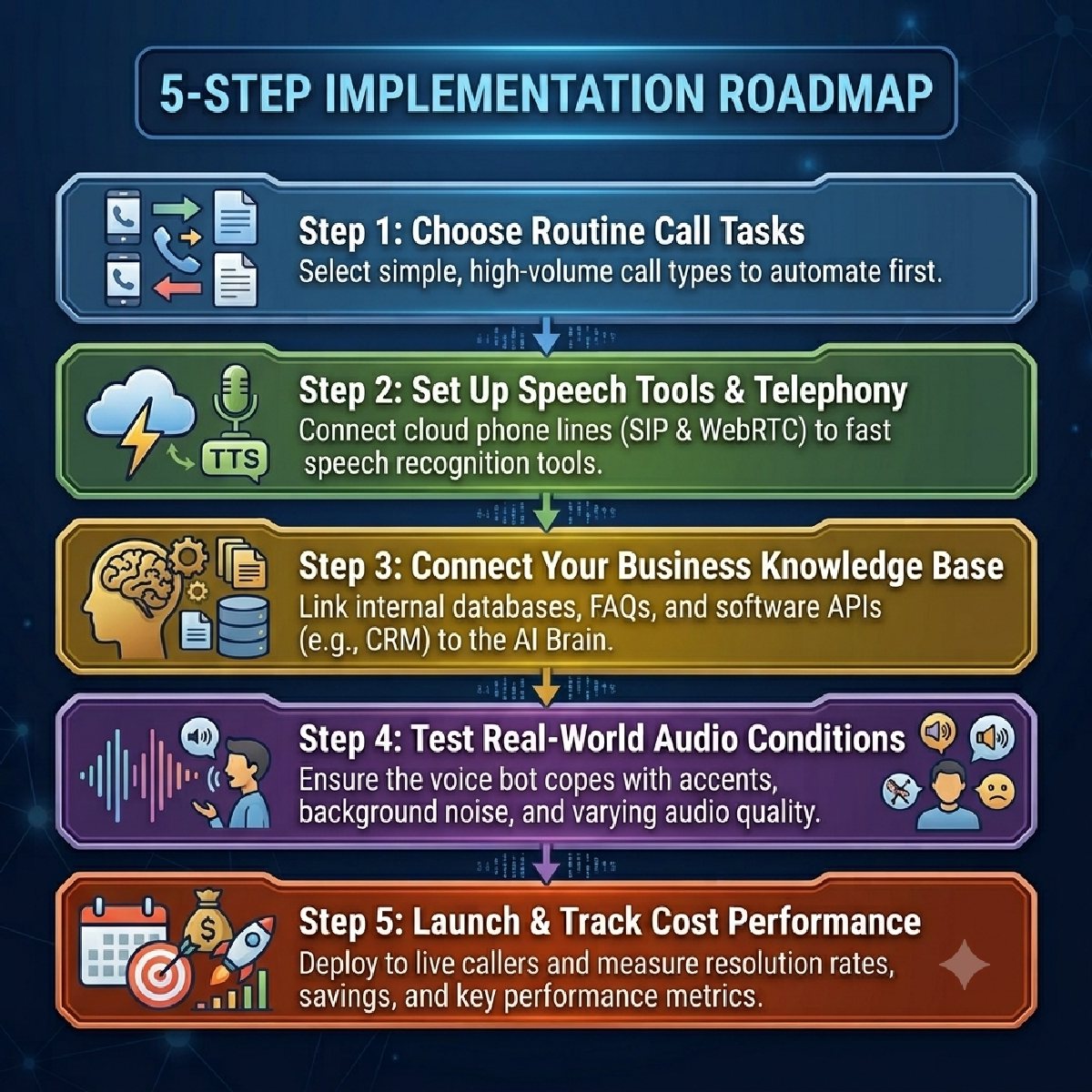
Step 1: Pick Routine Support Tasks First Identify high-volume, repetitive phone inquiries like appointment updates, payment verifications, or basic balance checks. Automate these easy workflows before moving to complex tasks.
Step 2: Configure Fast Speech Pipelines Set up low-latency speech-to-text and speech synthesis pipelines so that your voice agent talks back quickly without awkward pauses.
Step 3: Connect Your Business Data Feed the AI real company documentation so it gives accurate answers every time. For organizations building out specialized training systems, check out our insights on AI automation EdTech Evaluation Solutions.
Step 4: Test Under Real Call Conditions Test the voice agent against noisy environments, bad cellular connections, heavy accents, and callers interrupting the agent.
Step 5: Go Live and Monitor Results Launch the voice agent to take real calls. Track important metrics like call resolution rates, customer feedback, and overall reduction in support expenses.
Custom AI Development vs. Pre-Built Apps
While off-the-shelf voice applications promise fast setup, growing enterprise companies usually require custom voice AI agents built specifically for their internal software. Custom voice agents ensure full control over private customer data, avoid per-seat platform markups, and integrate cleanly with your existing databases.
If you are ready to eliminate long hold times and lower your operational support costs, learn more about our tailored solutions on our AI Development Services page or view our transparent development options on Envsoft Subscription Pricing.

