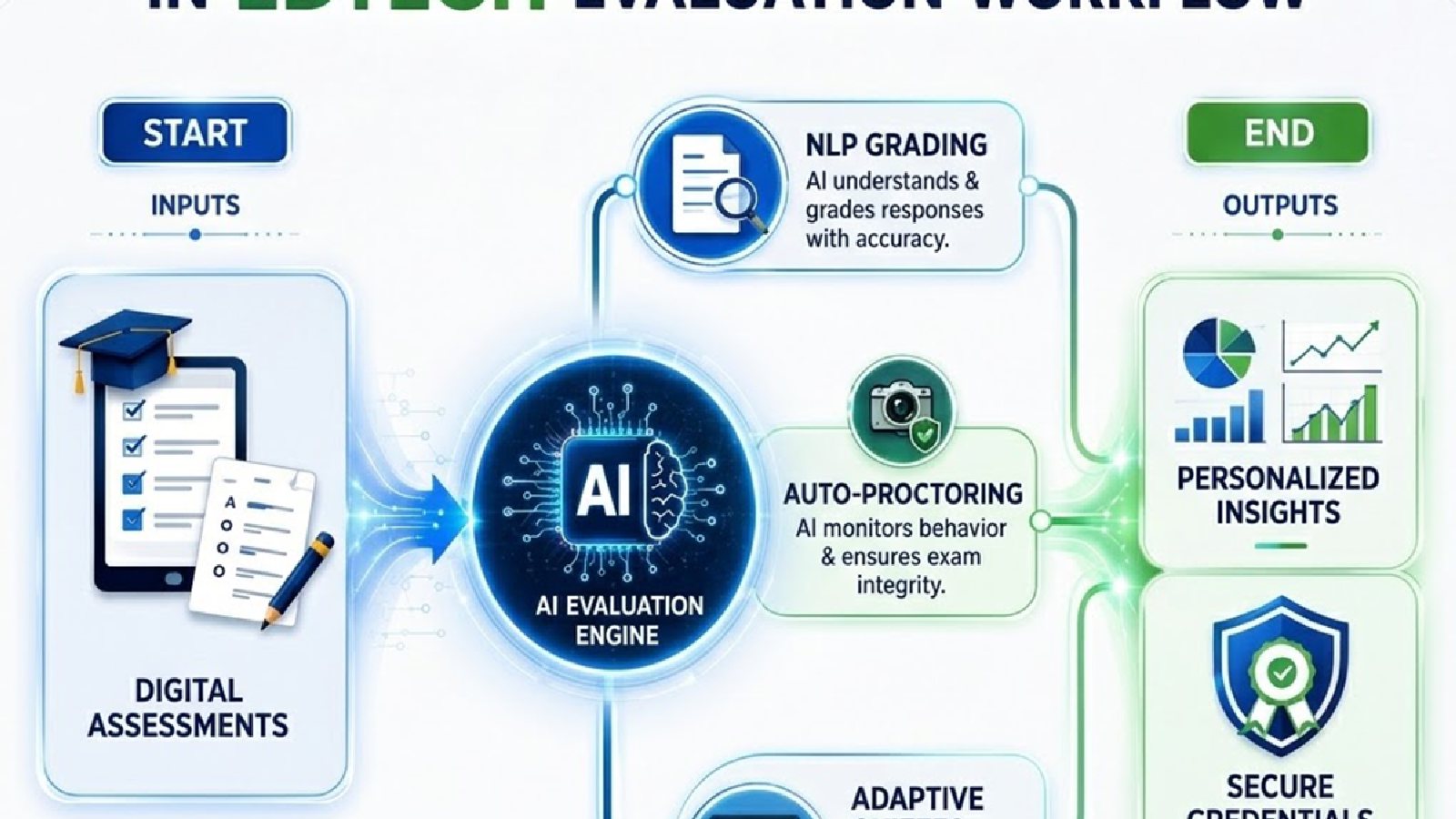
Everything you need to know about AI in EdTech evaluation in a 3-minute read.
The global education technology market is experiencing its biggest structural shift since the birth of e-learning. The AI in education market, which was valued at $𝟴.𝟯 𝗯𝗶𝗹𝗹𝗶𝗼𝗻 𝗶𝗻 𝟮𝟬𝟮𝟱 and is expected to reach more than $𝟱𝟳 𝗯𝗶𝗹𝗹𝗶𝗼𝗻 𝗯𝘆 𝟮𝟬𝟯𝟯, is moving beyond static multiple-choice tests to real-time, continuous evaluation systems.
Massive grading backlogs, administrative overhead, and security vulnerabilities are common with traditional exam formats. AI automation bridges this gap: schools, universities, and online platforms can assess thousands of students in an instant without compromising quality and security.
1. Automated Grading Beyond Multiple-Choice Questions
For years digital assessments were little more than simple quizzes with auto-grading. But open-ended essays, complex coding problems, and detailed subjective answers still required a human teacher to review.
Today, modern natural language processing (NLP) models can evaluate open-ended responses against rubrics in seconds.
Semantic comprehension Algorithms in artificial intelligence aren’t just looking for keyword matches; they’re looking at the context, the logical structure, and the flow of the argument.
Immediate feedback for students Learners get actionable feedback in moments of submitting their assignments so they can close their learning gaps.
Bias Reduction: All submissions are graded automatically against the same criteria, removing any subjective bias from the grading process. ive grading bias.
Key Fact: Research shows that educational institutions using AI automation report up to 86% adoption rates for generative tools, with automated workflows saving educators hundreds of hours in administrative tasks.
2. Dynamic, Adaptive Testing That Eliminates Rote Learning
Static past papers lead to answer leaks and rote learning. AI-enabled testing platforms are tackling this problem by building dynamic, adaptive assessments that are customized for each learner.
Difficulty adjustment If a student gets a question right, the platform will move the student up a level of difficulty. If they stumble, the system makes an adjustment to check the basics.
Algorithmic question generation AI models use huge item banks, mixing and matching variables/parameters so that no two students get the same set of questions.
Institutions modernizing their assessment frameworks can explore our guide on switching from paper to online exams to learn how to transition smoothly without losing assessment rigor.
3. Preserving Academic Integrity with AI Proctoring
With remote and hybrid learning now mainstream, securing digital exams against misconduct is a top priority for credentialing bodies. Manual webcam monitoring by human invigilators is difficult to scale and expensive to maintain.
AI-powered proctoring algorithms analyze video, audio, and device feeds in real time to detect integrity flags:
Computer Vision & Face Tracking Detects unauthorized persons or missing examinees.
Anomaly Detection in Audio Background speech patterns and voices.
Browser & Environment Locking Prevents screen-switching, external browser tabs, or third-party tool usage during live exams. live exams.
"AI automation in proctoring doesn't replace trust—it builds expandable security so distance learning credentials hold the same institutional weight as on-campus degrees.
4. Unlocking Actionable Analytics for Educators
Evaluation is no longer just about passing or failing a test; it is about gathering actionable data. Automated evaluation platforms track detailed performance metrics across entire cohorts, alerting instructors to weak spots before final grades are submitted.
Feature | Traditional Evaluation | AI-Automated Evaluation |
Grading Speed | Days to weeks | Instant (Seconds) |
Question Format | Static paper or basic forms | Dynamic, adaptive item pools |
Feedback Loop | Delayed score cards | Immediate rubric-driven feedback |
Exam Integrity | In-person visual surveillance | Automated AI proctoring & behavior logging |
The Road Ahead for EdTech Evaluation
As AI advances, assessment will shift from a stressful end-of-term event to an invisible, ongoing part of the educational process.
To see how modern platforms combine test creation, automated grading, and smart security into a seamless workflow, explore Proctor Plus for end-to-end online assessment solutions.

